



Whats up everybody! This submit goes to briefly cowl some matters regarding Hytale’s NPC framework, its present state, the way it seems to be, and the place we need to take it. A number of the content material is likely to be a bit extra technical, so be happy to skip via or skim the components that do not curiosity you. There’s additionally lots to cowl relating to NPC-related programs, so do not count on this one submit to be exhaustive!
The place we’re
Because it stands, the NPC framework helps all kinds of behaviours throughout a number of programs, all of that are configurable utilizing data-driven belongings. You needn’t know any programming languages to have the ability to set them up – even our most complicated NPCs are virtually totally data-driven.
We obtain this via quite a few totally different behaviour-related programs, however the two we’ll cowl on this submit are ‘Roles’ (the guts of our NPCs) and the ‘Fight Motion Evaluator’.
Documentation and Tutorial
If you wish to be taught extra about NPCs, our mates at hytalemodding have a number of nice documentation already and we supplied the generated NPC one in addition to a written tutorial.
Along with this tutorial we made a 6 half video collection, the place we cowl some components of it in additional element; for the perfect expertise use each:
Roles
Each NPC has a task. That is the expression of their normal behaviour and the way they will react to totally different stimuli on the planet. Altering an NPC’s complete behaviour set is so simple as altering its position, and we offer quite a few templates with customizable values that may be utilized to make creating new NPCs fast and environment friendly.
Along with the behaviour itself, the Position additionally dictates facets similar to how an NPC will transfer, what gadgets it carries, what it seems to be like, and so forth.
On the technical facet, this behaviour is represented by an idea we confer with as ‘instruction lists’. This is not too far faraway from choice timber or behaviour timber, however with a few of the semantics simplified. Every instruction is made up of a ‘sensor’ – a component that queries the state of the sport to determine if this instruction might be executed – in addition to the actions or motions the NPC ought to take if this instruction is chosen. Alternatively, the actions and motions might be changed by a nested instruction listing, giving rise to extra intricately constructable behaviours.
When you’re accustomed to behaviour timber, you would possibly marvel the place the precise variations lie – sensors are considerably analogous to decorators and it is nonetheless a tree-like construction. The secret is within the semantics we use for traversing our instruction lists. The place behaviour timber might observe totally different semantics relying on the node kind, we at all times observe the semantics of the fallback selector node. Every instruction is evaluated so as and – if matched – executed. Until particular flags are included within the instruction, we cannot consider any additional directions within the listing. This ensures that the circulate of logic inside the NPC is simple to observe, regardless of how giant or deep the timber develop.
Whereas all the person aspect varieties (sensors, actions, motions, and so forth) are written in Java, the instruction lists are constructed totally in JSON. At this stage we now have greater than 150 totally different aspect varieties that may be mixed to construct behaviours and a framework in place to make it straightforward for modders so as to add extra with Java. Not all of them are in a completed state, however we’re actively working to iterate on them and add as many extra as we will!
At its core, we designed our NPC framework to be interacted with on a number of totally different ranges. Whether or not you are fully new to modding and NPC design or a veteran in a position to craft complicated behaviours, we need to guarantee there are methods for everybody to have the ability to carry their creations to life.
Right here is an instance of fixing the Sheep position to go from a Livestock conduct enabled by Template_Animal_Neutral to being aggressive with the assistance of Template_Predator.
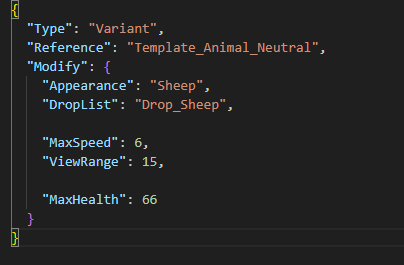
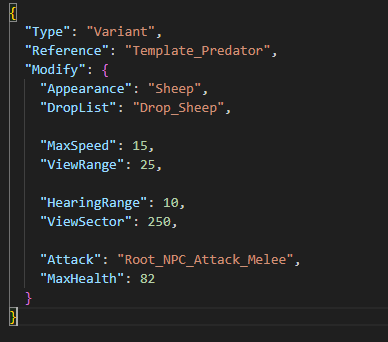
And it goes from being keen on you to attacking.
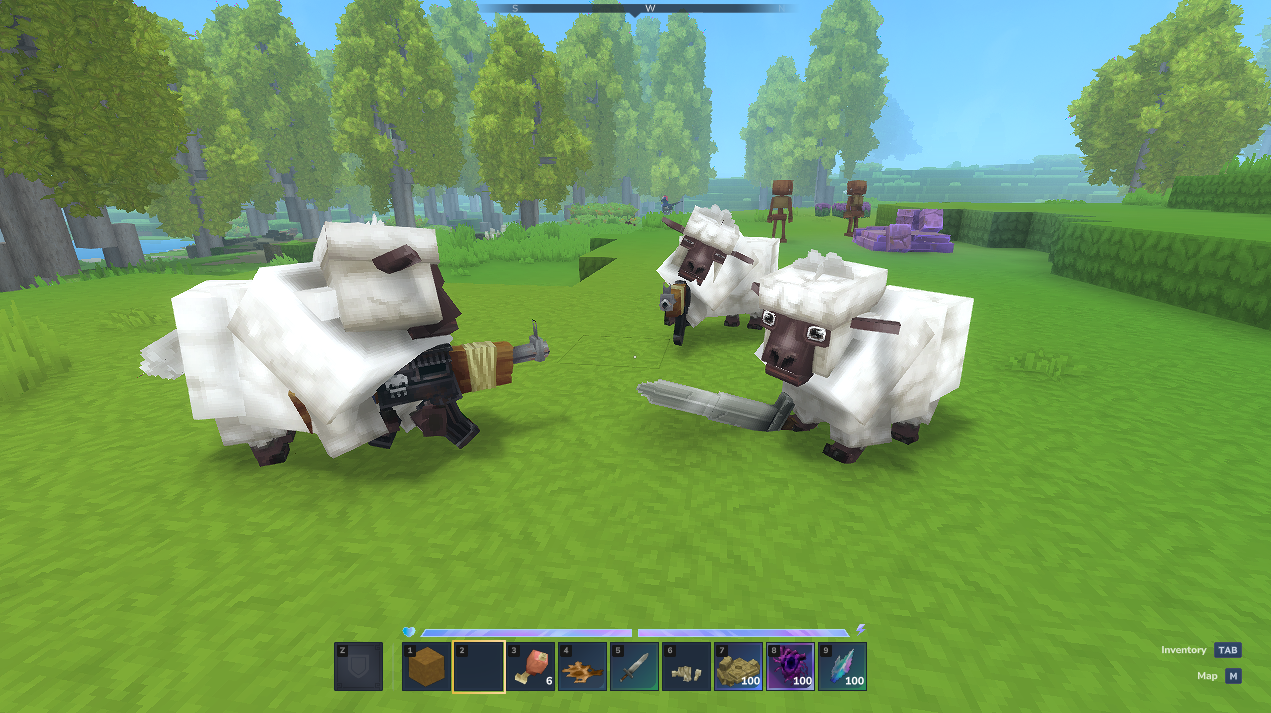
With some fundamental templates we created, it’s also possible to give it a random Weapon and you’re prepared for Die Onerous Sheep mod
The Fight Motion Evaluator
Although instruction lists already give designers quite a lot of flexibility to configure their NPCs and implement fight behaviours, crafting a personality that does greater than few fundamental assaults and must make some form of choice about when to make use of sure assaults shortly turns into cumbersome.
The fight motion evaluator exists to handle these wants, by providing a companion framework to an NPCs central behaviour that may make sensible moment-to-moment choices about its state, the state of the world round it, and its enemies or allies. Every attainable assault (or different fight motion) is assigned a set of situations that designate the perfect time to make use of it – when HP is low; when the enemy is shut; when a participant is attempting to sneak across the again. These situations are then evaluated and every motion is weighed towards the others to find out the plan of action the NPC needs to take.
Making choices this manner introduces a stage of ‘fuzziness’ to the NPC and results in extra fascinating fight encounters with much less verbose configurations. The draw back is that there is a steeper studying curve and NPCs won’t at all times act the way in which you count on! It is also not as performant, however that is one thing we hope to enhance with additional iteration.
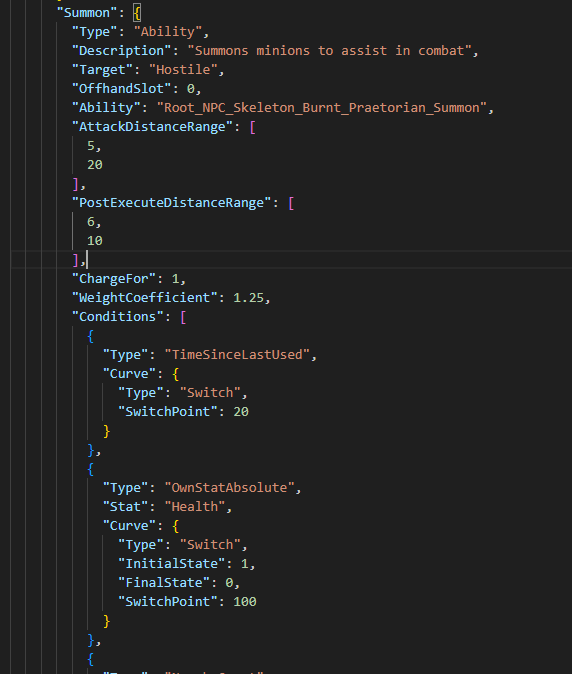
For instance, the Skeleton Praetorian can determine between utilizing totally different talents with a point of intelligence: blocking, summoning at low well being, and charging, alongside fundamental assaults.
Under is a snippet that exhibits a part of the configuration for the summon potential situation:
And here’s a video instance of these choices:
The truth test
This all sounds fairly far alongside, proper? Perhaps you would even consider it was shippable?
Nicely…no. There are nonetheless very many tough edges, lacking options, and areas in want of huge enchancment. Simply as we talked about what the programs can do, it is necessary that we speak about a few of the main areas the place we’re not fairly there but.
With nice energy comes…the necessity for nice tooling. We’re very far off the mark right here. There are plans for visible modifying and debugging, however proper now most NPC configuration is completed straight in JSON recordsdata utilizing textual content editors. It is workable, however painful, and although we offer a wide range of avenues for debugging NPCs after they do not work as anticipated, none of them are intuitive and most require studying via pages upon pages of detailed log recordsdata.
We talked about the educational curve related to the fight motion evaluator, however that applies just about in all places relating to working with NPCs as effectively. We envision a better and smoother onboarding into NPC modding, however at this stage we will solely supply a restricted variety of templates as examples together with documentation on out there components and easy tutorials.
There are many main lacking options as effectively. NPCs do not place themselves very effectively in fight; they do not use correct avoidance or flocking; whereas flying NPCs can land and take off, swimming NPCs cannot depart the water and vice versa. There is no finish to the listing of options we nonetheless want so as to add to have the ability to ship the sport we envision.
Naturally, the potential for efficiency points abounds. We are able to assist a comparatively giant variety of NPCs however there’s a lot work to be performed in making them extra performant, significantly relating to pathfinding. We preserve the pathfinder off as a lot as we will in any other case efficiency is prone to tank!
After which there’s all of the technical debt that must be solved, from NPCs not having the ability to intentionally break blocks outdoors of projectile-based explosions resulting from sure non-NPC system constraints that have to be revised (they’ll place them although!), to NPC physics needing a whole rework to unify it correctly with participant programs. There is a lengthy highway forward to get issues into correct form – and we did not even speak about spawning!
Bugs, bugs in all places
Many neighborhood members have identified the plethora of bugs that cropped up in launched gameplay footage. With our present growth tempo, a lot of that footage is already outdated and essentially the most important of these bugs have already been mounted! Nevertheless, I do particularly need to take a second to speak a bit extra about pathfinding, its challenges, and what that is prone to imply for launch.
Pathfinding is a big and complicated matter – complicated sufficient that many common video games wrestle with it. Once you add a procedural fully-modifiable block-based world to the combination, this turns into much more complicated since we will not depend on most of the tips video games use to optimize efficiency round identified terrain.
This implies our pathfinding is at present sluggish. Not so sluggish that it causes any noticeable efficiency points, however sluggish sufficient that we do not at present permit all NPCs to be utilizing it always and put extreme restrictions on its present capabilities. For this reason – for instance – cave raptors do not leap throughout gaps to chase after the participant. We will not pre-populate the world with ‘leap factors’ as a result of the world may change at any time and every block of further distance an NPC can leap over a niche is a big further value for each search.
We do not count on this to alter in time for the early entry launch, however we’re dedicated to bettering our pathfinding as a complete and have already begun work on growing a brand new technique that would resolve most of those points ought to it show viable.
So what’s subsequent?
Tooling is excessive up on our precedence listing. If we need to assist modders correctly, we have to give them the instruments they should make creating NPCs enjoyable! This would possibly not embrace a full suite of debugging instruments at first, however we’ll pull collectively what we will.
We additionally want to handle the problems with pathfinding and motion whereas coping with technical debt to make sure that we’re not creating efficiency bottlenecks when gamers face off towards a number of NPCs in complicated environments. There’s lots we will enhance on right here to be sure that fight feels pleasing, even at this early stage.
Including extra templates can even assist to enliven the world a bit extra, with bespoke behaviours introducing life to the cultures of Orbis’ many various species. These are additionally meant to function additional inspiration and examples for modders in search of to create their very own extra complicated NPCs – or can be utilized straight if the behaviour matches!
All of this leads in the direction of the potential for creating correct bosses – encounters that may push all our PvE programs to their absolute limits. There’s a number of work required to succeed in this level – way over has been listed right here – however we’re laying it out step-by-step and dealing our manner via it. With a bit extra time, we’ll make all of it work!
A headstart: debug instructions
This submit was initially written to be posted earlier than our early entry launch. Within the time since, we have put fairly a little bit of effort into attempting to make NPCs extra accessible to modders. Whereas we do not have a visible editor or deep debugging simply but, we have added quite a few totally different visualisations to make it simpler to grasp how your NPCs will perform (and tracked down quite a few bugs on our finish via utilizing them too!). A few of these options are nonetheless in growth, however here’s a sneak peak into our work in progress and what’s coming quickly in future releases.
Every of those visualisations might be enabled by toggling sure NPC debug flags on particular person NPCs. That is performed by utilizing the NPC debug command whereas holding the NPC in your view. You are able to do this by typing /npc debug set within the chat console in-game or by including the flags as a comma-separated listing within the Debug property of the NPC position itself. Working the command /npc debug presets supplies a full listing of obtainable flags and preset units of flags that can be utilized, however essentially the most helpful visualization flags are detailed under.
/npc debug set VisAiming
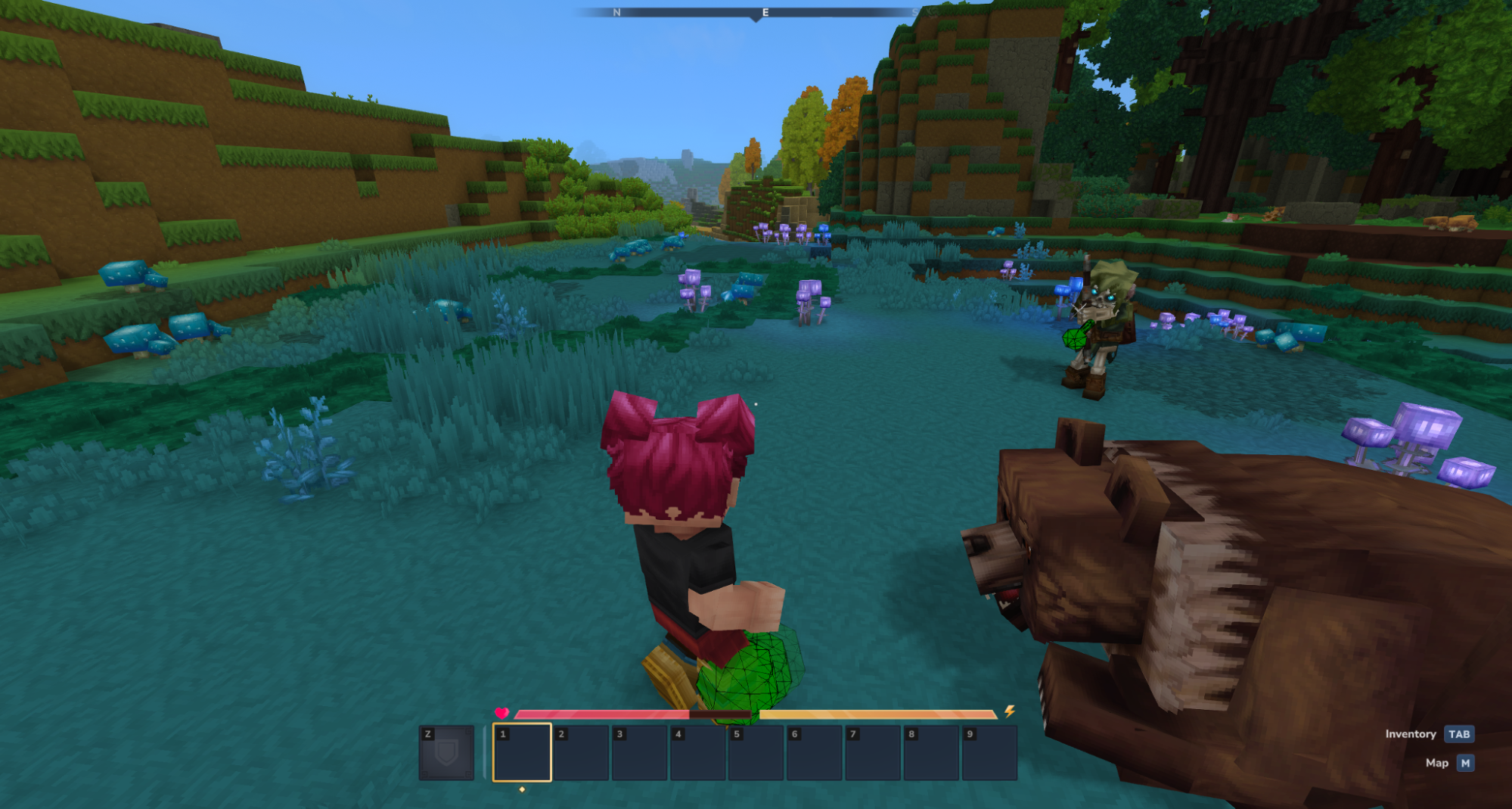
You should utilize it to find out what the NPCs truly shoot at. Works for NPCs which have purpose directions of their logic.
/npc debug set VisMarkedTargets
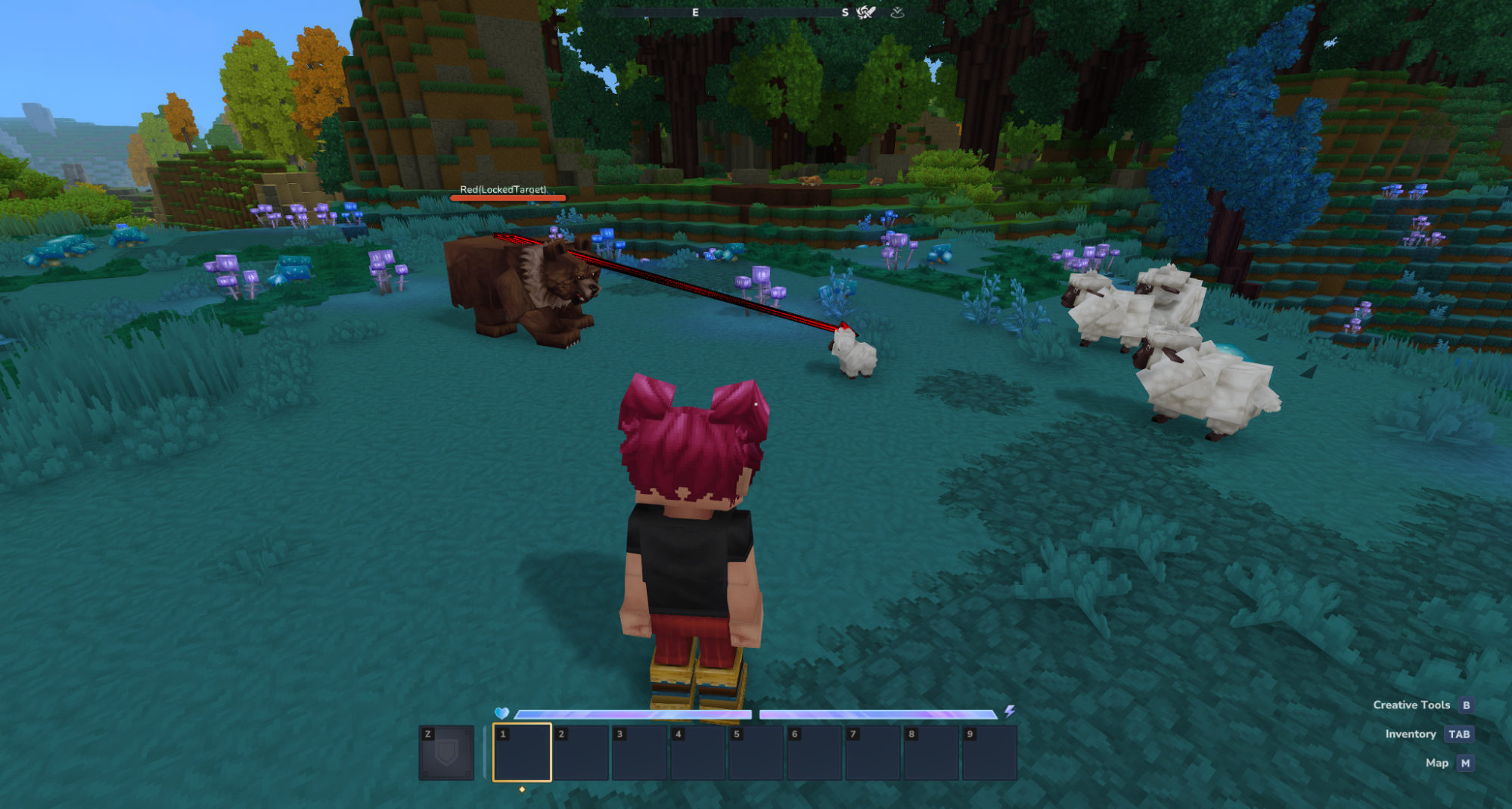
Visualises all present marked targets locked onto by the NPC. In most of our customary templates, the NPC has a single LockedTarget which is normally the entity they’re actively engaged in fight with. Helpful for understanding how and when the NPC adjustments focus, in addition to precisely what their present focus is in a crowd.
/npc debug set VisSensorRanges
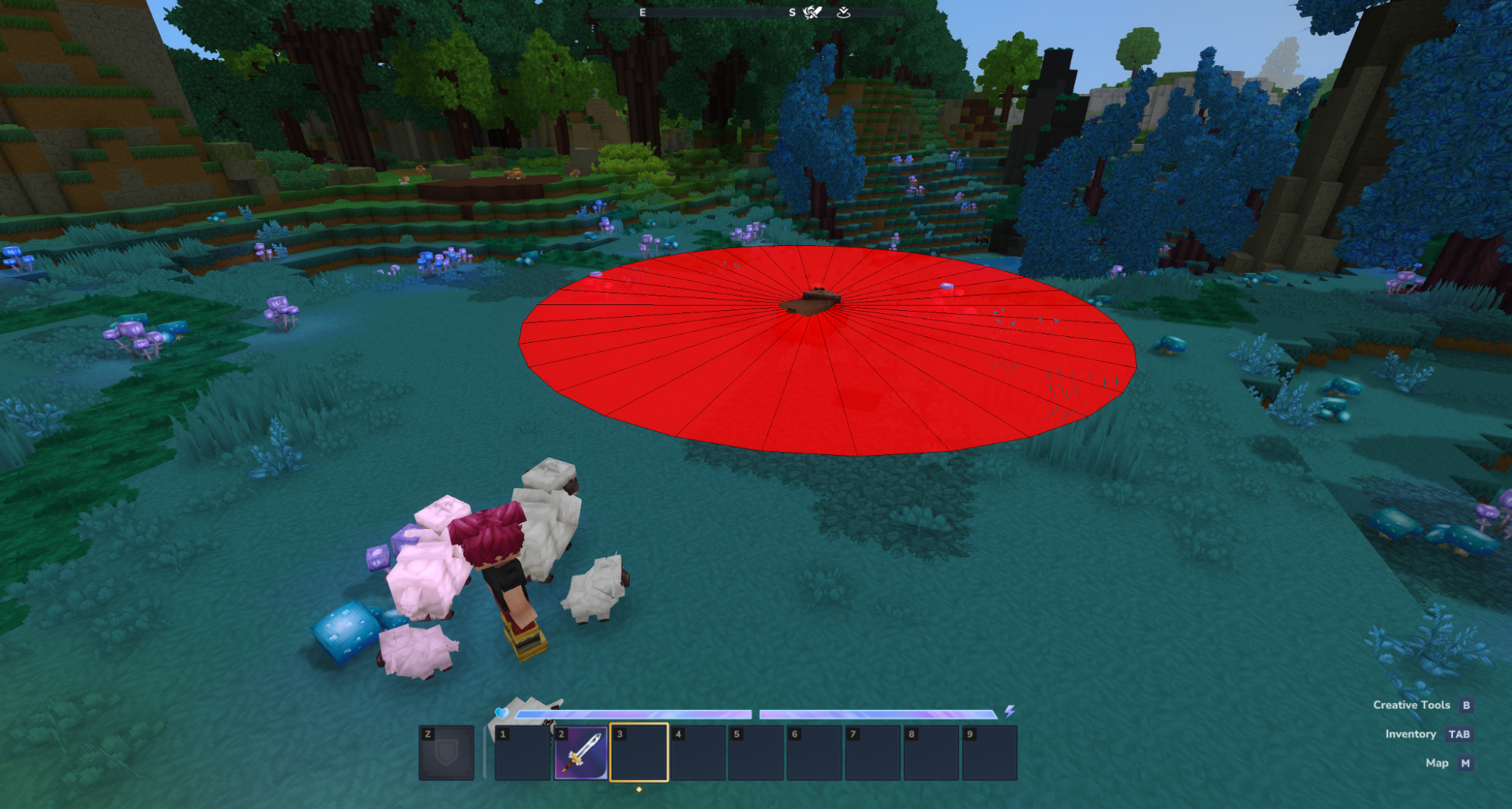
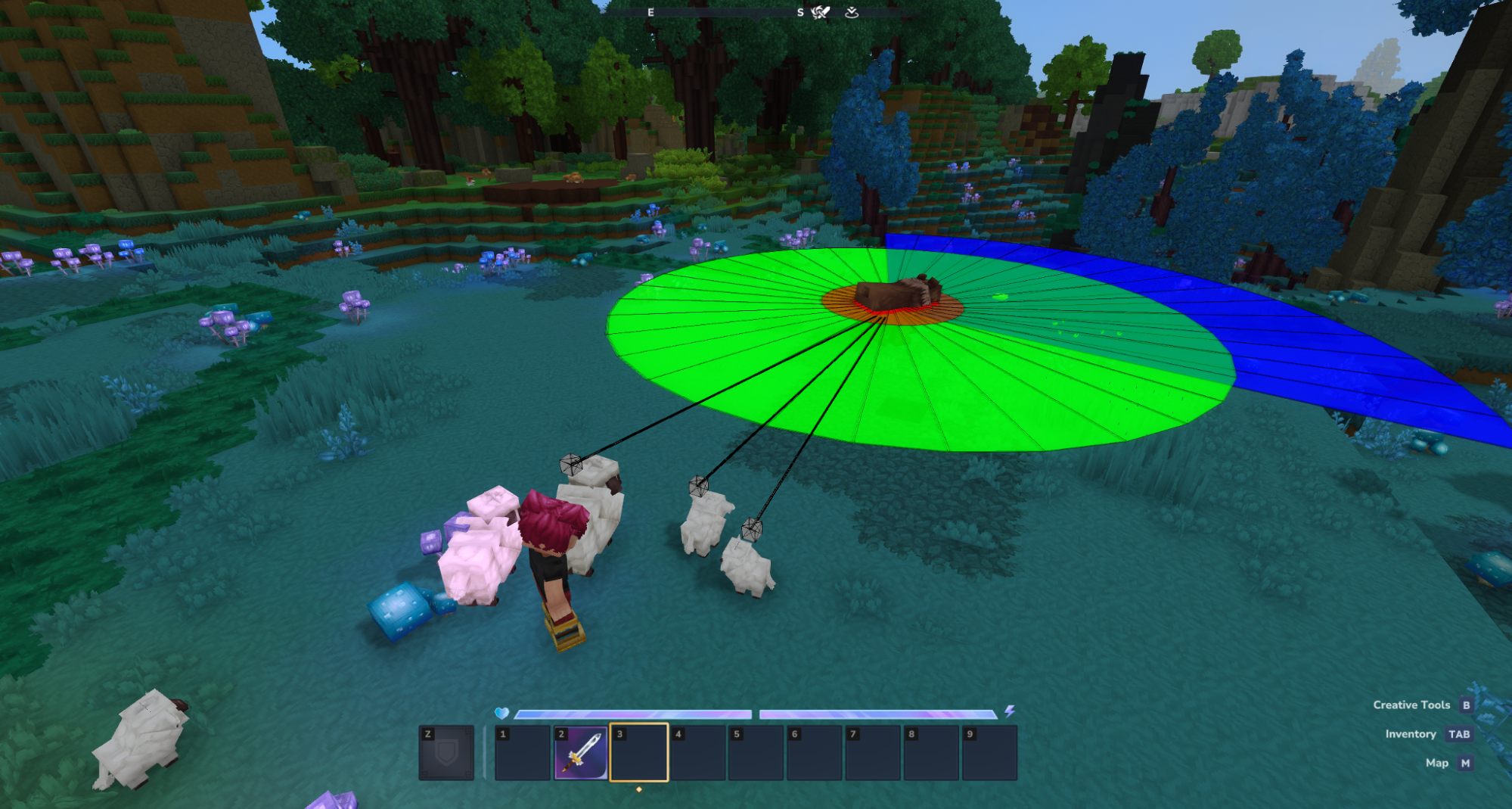
Visualises all at present checked Mob sensor ranges as rings and think about sectors, in addition to which entities in vary are being matched by which of those sensors. With how these sensors are usually utilized in our NPCs, this provides a fast visible overview of the ‘sensory capabilities’ of an NPC. Word that although these are displayed as sectors and rings, they’re technically spheres and cones that may be bounded by top situations.
The primary screenshot exhibits the Bear sleeping and solely having one sensor energetic. On the second screenshot the Bear has listening to, imaginative and prescient, and absolute detection vary. Though the Sheep are detected by the imaginative and prescient radius (they’ve goal marks) they’re outdoors of the view cone. The sheep household continues to be secure!
/npc debug set VisLeashPosition
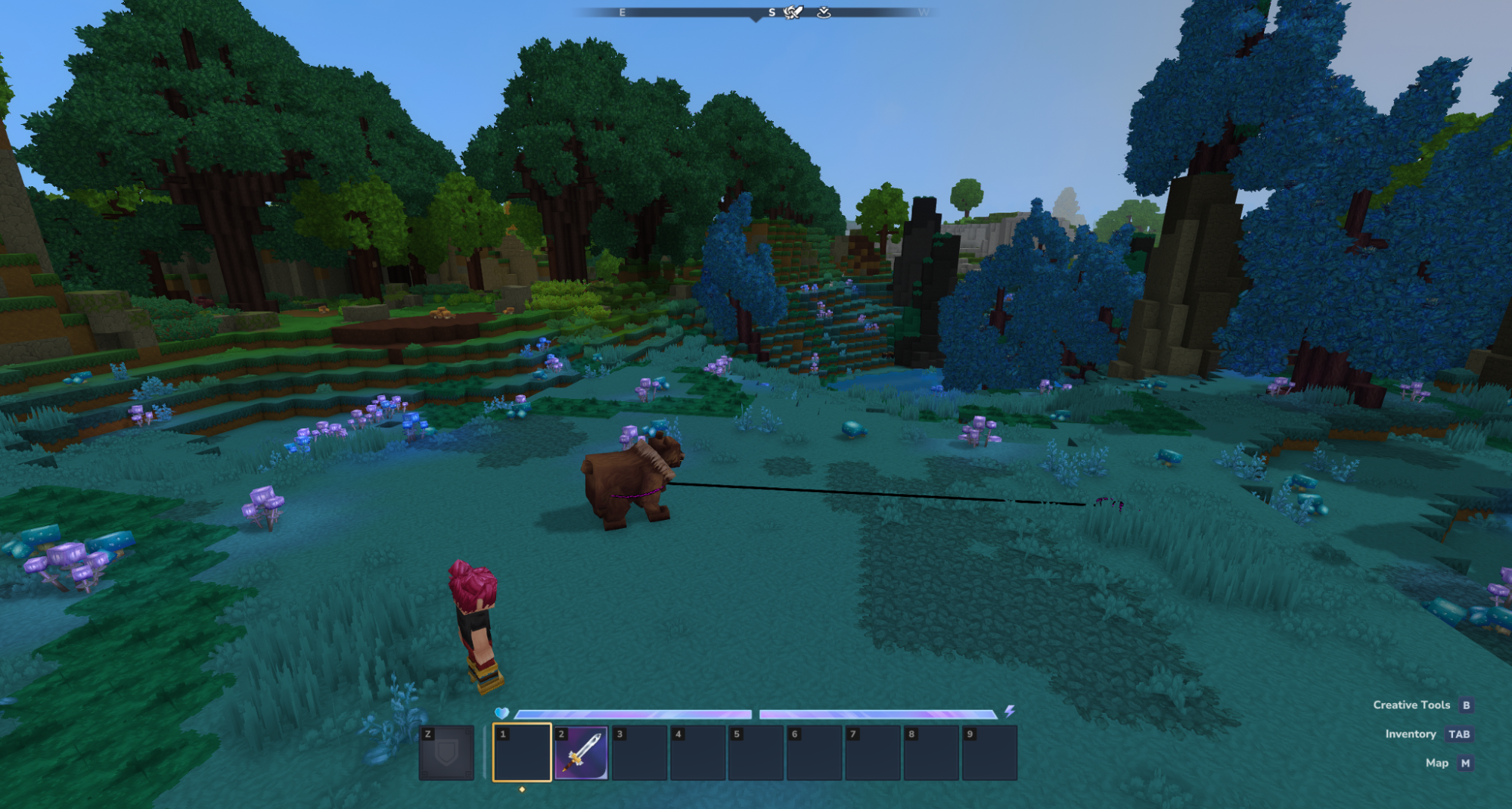
Visualises the NPC’s present leash place.
/npc debug set VisFlock
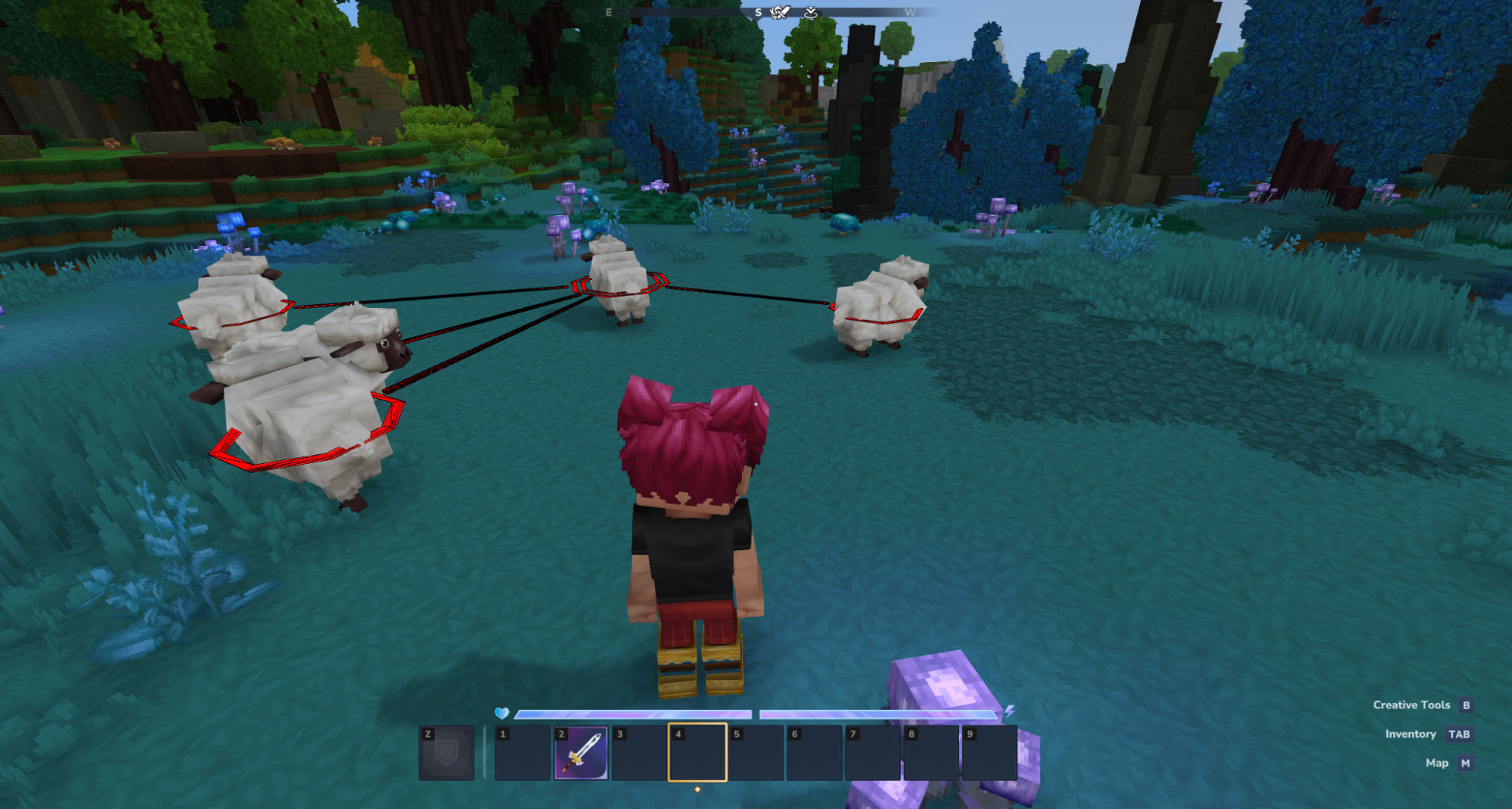
Visualises the flock (NPC group) related to this NPC. This show consists of marking the chief of the flock and all NPCs which might be at present members of the flock.

